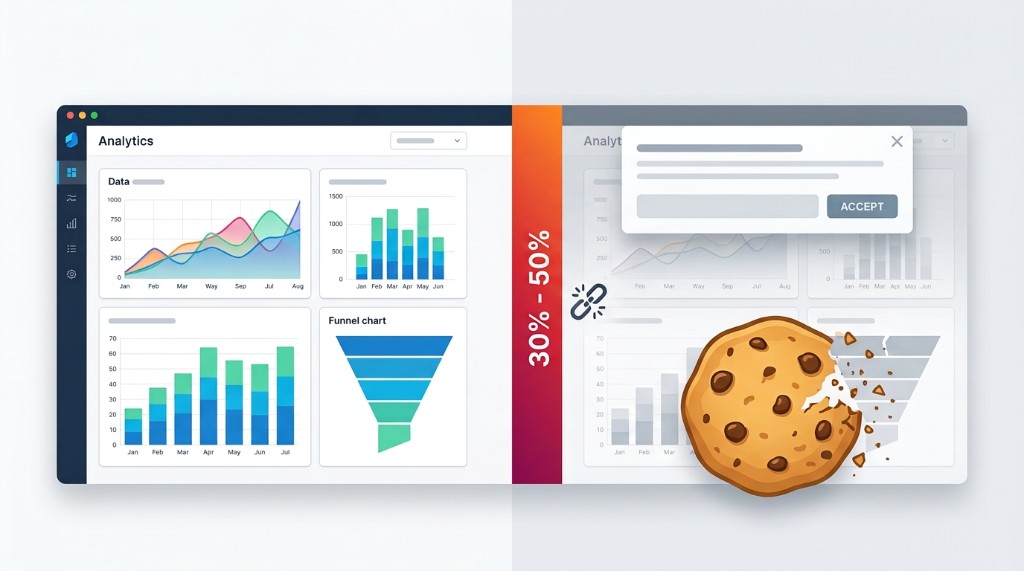
The era of third-party cookies is ending. Major browsers are phasing them out, privacy regulations are tightening, and users are demanding more control. Here's what businesses need to know about the transition and how to adapt.
The Death of Third-Party Cookies
Third-party cookies have been the backbone of web tracking for decades, but their days are numbered. The timeline has been clear: Safari blocked third-party cookies by default in 2017, Firefox followed in 2019, and Google Chrome—which holds over 65% of the global browser market share—began phasing them out in 2024, with full deprecation expected by late 2024 to early 2025.
This isn't just a browser decision—it's a response to growing privacy concerns, GDPR and CCPA regulations, and user demand for more control over their data. The writing has been on the wall for years, but many businesses are still unprepared for the impact.
The Current State
As of 2025, the cookie landscape looks like this:
- Safari: Third-party cookies blocked by default since 2017 (ITP)
- Firefox: Third-party cookies blocked by default since 2019 (ETP)
- Chrome: Phasing out third-party cookies throughout 2024-2025
- Edge: Following Chrome's timeline
Combined, these browsers represent over 90% of global browser usage, meaning the vast majority of web traffic is already or will soon be cookie-free.
Why This Matters for Your Business
If you rely on traditional analytics tools that depend on cookies, you're already facing significant challenges. Marketing teams report reduced targeting capabilities, attribution challenges, and difficulties measuring campaign success and return on investment. Cross-site tracking has become increasingly unreliable, making it harder to understand customer journeys across different websites.
The impact is real: businesses are seeing decreased ad relevance and effectiveness, complications in measuring campaign success, and challenges tracking user journeys across sites. However, this shift also presents an opportunity. Privacy-first analytics solutions are emerging that use alternative identification methods—such as server-side tracking, first-party data collection, and machine learning—to provide insights without relying on cookies.
Specific Challenges Businesses Face
- Reduced targeting capabilities: Without third-party cookies, delivering hyper-targeted ads becomes difficult
- Attribution challenges: Measuring campaign success and ROI becomes complicated without cross-site tracking
- Data loss: Traditional analytics tools lose visibility into user behavior across different sites
- Compliance costs: Managing cookie consent banners and GDPR compliance adds overhead
The Cookie-Free Alternatives
As cookies fade away, several alternative approaches have emerged. Each has different strengths and use cases:
1. First-Party Data Collection
Building direct relationships with customers through consent-based data collection. This includes gathering data directly from users via website interactions, newsletter sign-ups, and other voluntary methods. First-party data is more reliable, privacy-compliant, and valuable than third-party data.
2. Server-Side Tracking
Collecting data directly on the server reduces reliance on browser-based tracking and is less susceptible to ad blockers. This approach provides more reliable data collection while maintaining user privacy.
3. Contextual Advertising
Serving ads based on the content of the webpage rather than user behavior allows for relevant advertising without tracking browsing history. This method aligns advertisements with the user's current interests without privacy concerns.
4. Privacy-First Analytics Platforms
Modern analytics platforms use alternative identification methods that don't rely on cookies:
- Limited fingerprinting: Using basic browser and device characteristics (not invasive)
- Machine learning: Advanced algorithms that identify patterns and anomalies
- Behavioral analysis: Understanding visitor intent through engagement patterns
- No personal data: Everything is anonymous and privacy-compliant by default
The Future is Privacy-First
The shift away from cookies isn't just about compliance—it's about building trust with your users. Privacy-first analytics give you the insights you need while respecting user privacy, creating a win-win situation.
Modern privacy-first analytics platforms are designed to work within these new constraints. They typically offer high identification accuracy without cookies, built-in GDPR compliance, and advanced features like intent scoring and accuracy metrics that help you understand visitor behavior more deeply.
Popular Cookie-Free Analytics Tools
Several privacy-focused analytics platforms have emerged as alternatives to cookie-based tracking. Here are some options businesses are exploring:
Open-Source & Self-Hosted Options
- Matomo: Open-source platform emphasizing data ownership and user privacy, with features like e-commerce tracking and heatmaps
- Plausible Analytics: Lightweight, open-source alternative that delivers essential analytics without cookies or tracking personal data
- PostHog: Open-source analytics tool offering event-based tracking, session recordings, heatmaps, and A/B testing
Hosted Privacy-First Solutions
- Fathom Analytics: Straightforward, privacy-centric tool that operates without cookies, ensuring regulatory compliance
- Simple Analytics: GDPR-compliant tool that emphasizes user privacy by not using cookies, with clear reports and event tracking
- Swetrix: Open-source, GDPR-compliant platform providing real-time analytics and user journey visualization without cookies
What to Look For in Cookie-Free Analytics
When evaluating analytics solutions that don't rely on cookies, consider platforms that:
- Provide accurate visitor identification without cookies or invasive tracking
- Offer GDPR, CCPA, and other privacy regulation compliance by default
- Include essential analytics features like page views, events, and user journeys
- Maintain transparency about data collection and processing practices
- Enable easy integration with minimal code changes
- Provide real-time or near-real-time data updates
- Offer data ownership and export capabilities
Actionable Next Steps
- Audit your current setup: Identify which analytics tools rely on cookies and assess data loss
- Test alternatives: Try cookie-free analytics tools to understand their capabilities and limitations
- Build first-party data: Start collecting consent-based data directly from your users
- Update your privacy policy: Ensure it accurately reflects your new tracking methods
- Plan the transition: Develop a migration strategy that minimizes disruption
The transition to a cookie-less web is already well underway. By adopting cookie-free analytics now, you can future-proof your business while building stronger trust with your visitors. The businesses that adapt early will be better positioned to maintain accurate insights as cookies continue to disappear.
Siva J.P.
Privacy Research Lead at WysLeap