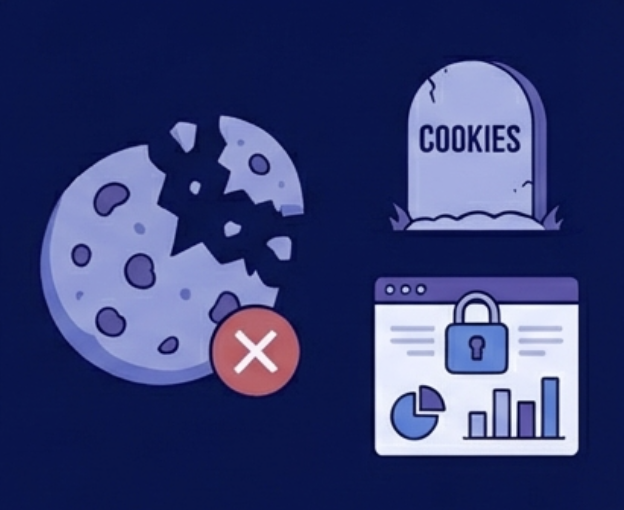
There's a number your analytics team isn't talking about. It doesn't appear in any dashboard. It doesn't trigger any alerts. And yet it may be the single most important figure affecting every business decision you make based on data.
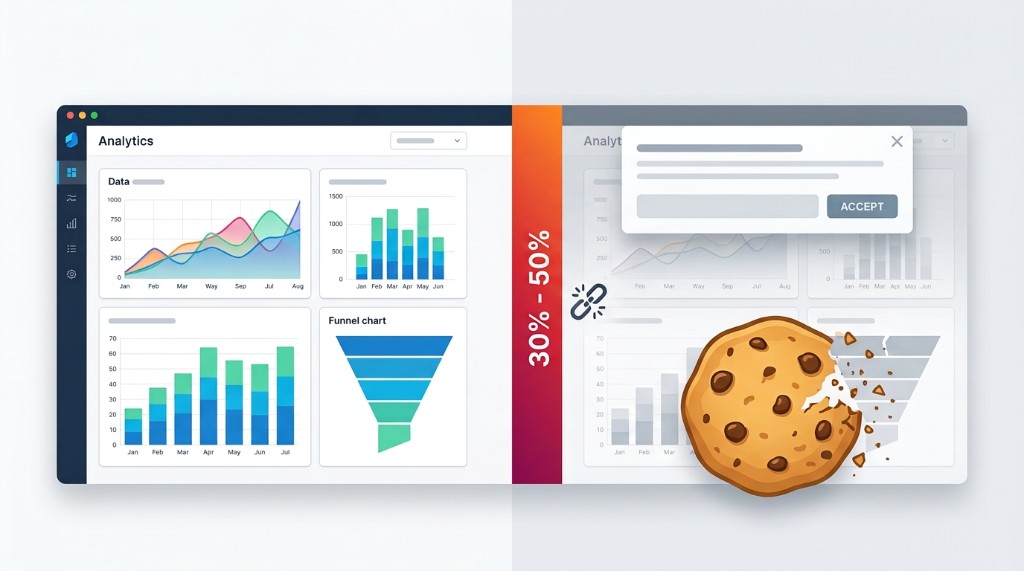
It's the percentage of your actual visitors who are completely invisible to your analytics platform — because they declined your cookie consent banner.
On average, 30–50% of visitors opt out of analytics tracking when presented with a consent banner.
In the EU, where GDPR enforcement is strictest and users are most banner-savvy, opt-out rates regularly exceed 50%. Your analytics platform is showing you a picture drawn from, at best, two-thirds of your real audience. At worst, half of it.
Why the Numbers Are Worse Than You Think
The 30–50% figure is striking enough. But the opt-out problem is more damaging than raw percentages suggest, because the visitors who decline tracking are not a random sample. They're skewed in ways that specifically distort your most important business decisions.
Tech-Savvy Visitors Opt Out at Higher Rates
Privacy-conscious, technically literate users are significantly more likely to decline tracking cookies. If you're a SaaS product, a developer tool, or any B2B company targeting sophisticated buyers — this is your audience. The very people making purchase decisions are precisely the ones most likely to be invisible in your analytics.
Result: your data systematically underrepresents the visitors most likely to become your customers.
EU Users Opt Out at 2x the Rate of US Users
European internet users have been conditioned by years of GDPR exposure to decline cookies by default. Research from consent management platforms shows EU opt-out rates consistently in the 55–70% range — far exceeding the global average.
Result: if Europe is a growth market for you, your analytics is almost certainly making it look smaller and less engaged than it actually is.
New Visitors Opt Out More Than Returning Ones
First-time visitors encounter your consent banner with no established trust. They decline more frequently than returning visitors who already have a relationship with your brand. This means your analytics data on new visitor behaviour — the exact data you need for acquisition optimisation — is the most incomplete.
Result: your funnel analysis and attribution models are built on a biased view of how new customers actually find and evaluate you.
The Compounding Effect
Each of these biases compounds the others. Your EU new-visitor data from technically sophisticated prospects could be missing 65–75% of actual traffic. You're not just missing data — you're missing the most commercially valuable data, consistently and systematically.
The Real Business Cost: Six Ways It Hurts
1. Wrong Attribution, Wrong Budget
If 40% of your organic traffic opts out of tracking, your analytics platform attributes 40% fewer organic conversions. Google Ads looks proportionally better, even though the actual contribution of paid vs. organic hasn't changed. You shift budget toward paid based on data that was never balanced to begin with.
2. Conversion Rate Miscalculation
Your reported conversion rate is conversions divided by tracked sessions. If 40% of sessions aren't tracked, your denominator is artificially small — making your conversion rate look better than it is. Teams make product decisions based on a conversion rate that's an artefact of consent mechanics, not actual performance.
3. A/B Test Results You Can't Trust
A/B tests require representative samples. If your experiment is running on only 60% of visitors — and that 60% is systematically different from the 40% who opted out — your results are drawn from a biased sample. Winning variants declared from consent-platform data may not actually win with your full audience.
4. Funnel Analysis With Holes in It
Funnel analysis depends on following a visitor through multiple steps. If a visitor declines cookies at entry, they're invisible across every step. Your funnel report shows users “disappearing” — but many of them didn't leave. They just became untrackable. You optimise the funnel based on a ghost audit rather than reality.
5. Retargeting That Misses Its Audience
Retargeting audiences are built from cookied visitors. Every user who declined tracking is automatically excluded from your retargeting pool — regardless of how interested they were in your product. You're serving ads to the more casual, cookie-accepting visitors and ignoring the privacy-conscious prospects who may have been closest to buying.
6. Content Strategy Built on Partial Evidence
Which blog posts drive conversions? Which landing pages perform? If 40% of your readers aren't tracked, your content performance data is incomplete at best. You double down on content that appears to perform — but your measurement is only sampling the easier-to-track segment of your audience.
Dark Patterns Don't Fix It — They Make It Worse
Many companies respond to low consent rates by making the banner itself more manipulative: burying the "Decline" button, using dark UX patterns, requiring multiple clicks to opt out, or pre-checking all consent boxes. This is both legally risky and strategically self-defeating.
The Regulatory Crackdown Is Accelerating
The French CNIL, the Irish DPC, the German DSK, and the UK ICO have all issued explicit guidance that consent obtained through dark patterns is not valid consent. GDPR fines for manipulative consent practices have reached into the tens of millions of euros. In 2025, the EU enforced a record number of consent-related violations.
Beyond legal risk: users who are tricked into consenting generate lower-quality data anyway. They're less engaged, less likely to convert, and more likely to return to decline later.
The Only Sustainable Answer Is Not Needing Consent
The most durable solution to the consent banner data gap is an analytics approach that doesn't require consent in the first place — because it doesn't collect personal data or track individuals across sites using persistent identifiers. That's the premise of privacy-first analytics.
What Privacy-First Analytics Does Differently
Privacy-first analytics platforms — including WysLeap — operate on a fundamentally different principle. Instead of using persistent cookies to track individual users across sessions, they derive insights from behavioral signals that don't constitute personal data under GDPR.
No Consent Banner Required
Under GDPR Article 6, processing that falls under "legitimate interest" and doesn't involve personal data doesn't require a consent banner. Privacy-first analytics avoids collecting:
- IP addresses stored in identifiable form
- Cross-site tracking identifiers
- Persistent cookie-based user profiles
- Any data that can be linked back to a specific individual
The result: 100% data capture. Every visitor appears in your analytics — not just those who consented.
How Visitor Identification Works Without Cookies
Privacy-first platforms use a combination of signals that, in aggregate, can identify returning visitors with high accuracy — without storing any personally identifiable data:
- Browser characteristics: Screen resolution, timezone, language settings, installed fonts, user-agent entropy — combined, these create a near-unique fingerprint that identifies a device without storing anything on it.
- Behavioral patterns: Navigation speed, scroll patterns, interaction timing — anonymised behavioral signatures that distinguish visitor types without identifying individuals.
- First-party session signals: In-session context that expires and isn't persisted beyond the visit window.
WysLeap achieves 95–99.5% accuracy in identifying returning visitors using this approach — on par with cookie-based tracking, without the consent requirement.
What the Numbers Look Like, Side by Side
Here's how the two approaches compare in practice, based on real-world data from sites that have switched from consent-dependent to privacy-first analytics:
| Metric | GA4 / Hotjar (with banner) | Privacy-first analytics |
|---|---|---|
| Data capture rate | 50–70% | ~100% |
| EU visitor tracking | 30–45% of actual | ~100% |
| Consent banner required | Yes | No |
| GDPR compliance | Requires correct CMP setup | Compliant by default |
| Retargeting audience quality | Missing opt-out visitors | Full behavioral segments |
| A/B test validity | Biased sample | Full population |
The Real Question Isn't "How Do We Improve Consent Rates?"
Consent management platforms sell the idea that you can close the data gap by optimising your banner design. You can, marginally. Moving from 40% to 50% consent rates is achievable with good UX. Moving from 40% to 100% is not — because you're working against users' legitimate desire not to be tracked.
The real question is: why are you using an analytics approach that requires consent in the first place?
How to Actually Close the Gap: Three Approaches
Option 1: Switch to Privacy-First Analytics Entirely
The cleanest solution. Replace consent-dependent tools with a platform like WysLeap that collects behavioral data without cookies or personal identifiers. No banner needed. 100% data capture. GDPR-compliant by design.
Best for: teams who want accurate data and GDPR compliance without complexity.
Option 2: Hybrid Stack — Privacy Analytics + Consent-Gated Tools
Run a privacy-first platform for all core analytics (traffic, conversions, funnels, journey data) without a consent banner. Only show the banner for optional, consent-required tools — like marketing pixels. This gives you 100% analytics coverage while enabling ad personalisation for the subset who consent.
Best for: teams dependent on paid social advertising who still need marketing pixels but want accurate analytics.
Option 3: Server-Side Analytics as a Bridge
Move analytics data collection server-side, where it can operate under legitimate interest without client-side cookie consent. This is more complex to implement but works within most existing analytics stacks. A consent banner can still exist for marketing tools without affecting core analytics.
Best for: large teams with existing analytics infrastructure who need time to migrate.
Stop Making Decisions on Half Your Data
WysLeap captures 100% of your visitor data without cookie consent banners — fully GDPR compliant, no personal data collected. See what your analytics has been missing.
Siva J.P.
Privacy Research Lead at WysLeap