Every website has two kinds of visitors: those who are just browsing, and those who are about to do something. The challenge has always been telling them apart — before the moment passes.
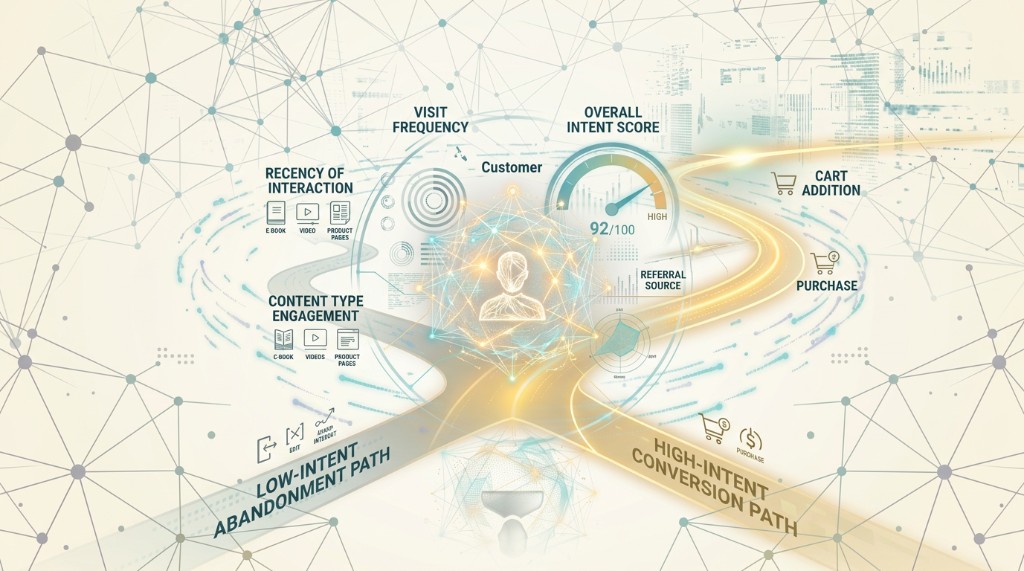
Traditional analytics can tell you what a visitor did after the fact. Intent scoring flips that. It watches behavior in real time and assigns a probability — a score from 0 to 100 — indicating how likely that visitor is to convert. Not eventually. Now.
"Intent scoring doesn't tell you who visited. It tells you who is about to act."
The difference sounds small. The commercial implications are enormous. A high-intent visitor is worth 10–30x more attention than a casual browser — and for the first time, you can tell them apart automatically, without asking them to fill out a form.
The Problem with "Tell Us Who You Are"
The dominant model of web lead capture has been around for thirty years: put a form on the page and ask visitors to identify themselves. It works — until you notice all the people who don't fill it out.
Forms Capture ~2% of Intent
Industry benchmarks put average B2B lead form conversion rates between 1.5% and 3%. That means for every 100 high-intent visitors to your pricing page, 97 leave without a trace. They wanted to buy. They just weren't ready to fill out a form. So you never knew they existed.
Intent scoring identifies all 100. The 3 who converted, and the 97 who didn't — but whose behavior told a story you could have acted on.
Forms Introduce Friction at the Worst Moment
A visitor who has read three blog posts, scrolled your pricing page twice, and spent four minutes on your features list is primed. Interrupting that moment with "Enter your work email to continue" breaks the flow. Intent scoring lets you know they're ready without asking them to announce it.
Forms are a proxy for intent. They were the best proxy available before behavioral ML. They no longer are.
The Signals: What the Model Actually Reads
Intent scoring is built on behavioral signals — things a visitor does, not things they tell you. Here's the signal taxonomy that a well-built intent model draws from:
Engagement Depth Signals
Page depth
How many pages in one session. A visitor who reads 7 pages signals stronger intent than one who reads 1.
Scroll depth
Did they read to the bottom of your pricing page, or bail at the first paragraph? 75%+ scroll on a conversion-focused page is a strong signal.
Time on high-value pages
Time spent on /pricing, /demo, or /features correlates strongly with conversion. General browsing time doesn't.
Click patterns
Clicks on CTAs, feature comparison tables, and testimonials indicate evaluation behavior. Clicks on nav menus and search suggest exploration.
Recency & Frequency Signals
Return visits
A visitor who returns three times in a week is researching, not just browsing. Return frequency is one of the strongest predictors of near-term conversion.
Recency
A visitor who was on your pricing page 2 hours ago is more likely to convert today than someone who visited 3 weeks ago.
Session acceleration
Visits that get longer and more focused over time. First visit: homepage. Second: blog. Third: pricing + demo page. The trajectory tells the story.
Time of day
B2B visitors during business hours on weekdays convert at higher rates than weekend browsers. The model learns your site's specific pattern.
Context Signals
Traffic source
A visitor from a branded search ("WysLeap pricing") converts at 3–5x the rate of a visitor from a generic blog post referral. Source carries prior intent.
Device type
For B2B SaaS, desktop visitors convert significantly more than mobile visitors. The model learns your specific mix.
Geography
Visitors from your strongest markets, or from cities with high concentrations of your ideal customer profile, carry a context bonus.
Page sequence
Certain page paths are highly predictive. Homepage → Features → Pricing → Demo request is a classic high-intent funnel. The model identifies yours.
What Intent Scoring Does NOT Use
A properly built intent model works entirely on behavioral signals. It doesn't require names, emails, company names, job titles, or any personally identifiable information. This is what makes modern intent scoring GDPR-compliant by design — and why it works without cookie consent banners.
The model reads what people do, not who they are.
How the Model Works: From Signals to Score
The signals above are inputs. The model turns them into a single number: an intent score from 0 to 100. Here's how that transformation happens, without the jargon.
Step 1: Feature Extraction
Every visitor action is converted into a numerical feature. "Visited /pricing" becomes 1. "Visited /pricing 3 times in 5 days" becomes 3 with a recency weight applied. "Scrolled 80% of /pricing" becomes a weighted decimal. Each interaction enriches the visitor's feature vector.
Step 2: Weight Assignment (Where the Learning Happens)
This is the core of the model. Each feature is assigned a weight that reflects how strongly it predicts conversion on your specific site. Not a generic industry model — your site's actual historical conversions. Generic models might assume "visited pricing page" is worth 20 points. But on your site, maybe visitors who come from LinkedIn are 4x more likely to convert than those from Twitter. Your model learns these site-specific weights from your actual conversion history.
Step 3: Continuous Adaptation
Static models decay. Visitor behavior changes with seasons, marketing campaigns, product launches, and market conditions. An adaptive intent model retrains continuously — every conversion becomes new training data, adjusting weights to reflect the current reality. WysLeap's adaptive intent scoring model updates weights using gradient descent every 100 conversions. After 500 conversions, accuracy typically improves 15–30% over the initial baseline model.
The Output: A Score and a Label
Every visitor gets a score (0–100) and a tier:
- High intent (70–100): Likely converting in this session or within 48 hours. Prioritise immediately — trigger live chat, personalise the page, alert sales.
- Medium intent (40–69): Actively evaluating. Worth nurturing — retargeting, educational content, case studies.
- Low intent (0–39): Early stage or casual. Don't over-invest. Let them explore and wait for signals to develop.
What You Can Actually Do With an Intent Score
Intent scoring without action is just an interesting number. Here's where the commercial value lives:
For Sales Teams: Prioritise Outreach
If your site has any sales component — demos, trials, direct sales — intent scores give your team a daily list of who to contact first. Not all leads are equal. A visitor who has been on your pricing page three times this week is a warmer lead than one who signed up to a webinar six weeks ago. Treat them differently.
For Product Teams: Personalise the Experience
A high-intent visitor seeing your homepage for the third time shouldn't see the same hero as a first-time visitor. Show them the demo CTA, a testimonial from their industry, or a limited-time offer. Personalisation based on intent beats personalisation based on demographics — because it reflects what the person is actually doing right now.
For Marketing Teams: Smarter Retargeting
Retargeting everyone who visited any page wastes budget. Retargeting only high-intent visitors — those who scored 70+ — concentrates spend where it converts. Some WysLeap customers have cut retargeting spend by 40% while improving conversion rates by targeting high-intent visitors exclusively.
For Live Chat: Trigger at the Right Moment
Proactive chat prompts that fire on every visitor after 30 seconds are annoying and convert poorly. Prompts that fire only when a visitor scores above 75 and is on the pricing page for the second time in three days convert at 3–5x the average rate. Intent makes your chat tool intelligent instead of aggressive.
Intent Scoring in Practice: Industry Examples
E-Commerce
High-intent signals: visited a product page 3+ times, added to cart without purchasing, filtered by size/colour (indicating they're past browsing and into evaluating), returned within 24 hours. A score above 75 on an e-commerce site reliably predicts same-session or next-session purchase.
Action: Trigger a "limited stock" nudge or free shipping offer only for high-intent visitors on product pages.
B2B SaaS
High-intent signals: visited /pricing, viewed the Enterprise plan specifically, read 2+ case studies, returned from a branded search, visited during business hours on a weekday. SaaS evaluation cycles are longer, so medium-intent visitors also matter — they're worth nurturing.
Action: Surface high-intent visitors as PQLs (product-qualified leads) for sales teams to follow up. Enrol medium-intent visitors in an automated nurture sequence.
Content & Media
High-intent signals: read 5+ articles in one session, scrolled to the paywall multiple times, visited subscription pricing page, came from email newsletter (indicating existing relationship). For media, "conversion" means subscription — and intent scoring identifies who is one nudge away.
Action: Show a personalised subscription offer only to visitors scoring 70+, without a generic popup that annoys everyone else.
3 Common Misconceptions About Intent Scoring
"You need a huge dataset to start"
A basic model can work with as few as 50–100 conversions. It won't be perfect, but it will be meaningfully better than nothing. The model improves continuously as more conversions come in — you don't wait until you have enough data, you start and let it learn.
"It requires personal data or cookies"
Intent scoring built on behavioral signals requires zero personal data. No email, no name, no cookie consent. All signals are derived from anonymous behavioral patterns — making it GDPR-compliant by design and cookieless by default.
"High score always means they'll convert"
Intent scoring is probabilistic, not deterministic. A score of 90 means high probability of conversion, not certainty. The goal is resource allocation — focus more energy on high-intent visitors, not guarantee they'll buy. Done right, it dramatically improves conversion rates across the board.
See Which of Your Visitors Are High-Intent Right Now
WysLeap's adaptive intent scoring works from day one — no configuration, no cookies, no personal data required. The model learns from your actual conversions and gets more accurate over time, automatically.
Start Free — No Credit Card NeededSiva J.P.
Privacy Research Lead at WysLeap